Virtual Machine's Results
Monitoring Virtual Machine's Results
Monitoring the simulation is actually the responsibility of CERUN and
GENER. GENER monitors the simulation during look-ahead operations
(activated by LINTOL/
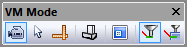
VM provides various controls and features to aid visual monitoring of
the simulation. Two of these, the HUD (head-up display) and tool path
displays, can both be toggled from the VM Mode toolbar, as well as from
the Simulation»

The VM View Filter toolbar provides toggle buttons to display or hide
various types of objects in the scene, such as (from left to right): the
machine, tools, fixtures, rough stock and design part. When running with
MRS (material removal simulation) active, additional toggle buttons are
available to view or hide: the in-process stock, in-process stock
checkpoints, Boolean overcut and undercut stock (gouge and excess
material), a color graduated Boolean difference between part and stock,
and a cross section cutout of the stock. These view filter toggles are
also available from the Simulation»
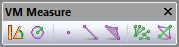
VM provides various functions to measure the distance and angles between objects. Measurement mode is toggled using a button on the VM Mode toolbar. Once in measurement mode, clicking with the left-mouse button causes measurements to be taken between the selected objects. Press and hold the Ctrl key to manipulate the camera with the mouse while taking measurements. Within VM, objects are constructed of triangles. The VM Measure toolbar provides a middle series of three toggle buttons that filter the parts of the triangles that can be selected with the mouse. The left-most toggle on the VM Measure toolbar switches between chained (one to the next) and fanned (one to many) measurements. The rightmost toggle affects the visibility of the objects being measured; when in “overlay” mode they will not be hidden by other objects that might be between you (the viewer) and the measured ones.
VM also provides a Time-Line feature on the VM Controller window that can be used to review and play back the simulation.
Finally, VM provides the ability to synchronize both the timeline display and the simulation window with any of the other tracing windows available with the CERUN and GENER UI. This can be used to see the state of the simulation at a particular CLDATA record, NC block, macro command and operator or diagnostic message (e.g., a collision).
Animation Control

Animation options are controlled from the VM Animation toolbar as well
as from the Simulation»
The animation control options affect the simulation display speed. Selecting the “Continuous” mode will slow the simulation down to a specified factor of real time within the limitations of the CPU and graphics capabilities of your computer. When “Motion Step” is selected, the display is updated at the specified interval in motions, meaning that the simulation display is updated after every n motion steps. A third “Time Interval” method refreshes the display at the specified interval in seconds, which has the least impact in terms of CPU requirements.
When in continuous animation mode, extremely slow motions may give the impression that the software is no longer operating. If unsure, activate the HUD motion display, which will show if axes are in fact moving. The Simulation Options dialog can be activated while the simulation is running (and even mid interpolation), allowing you to change the mode from continuous to another.
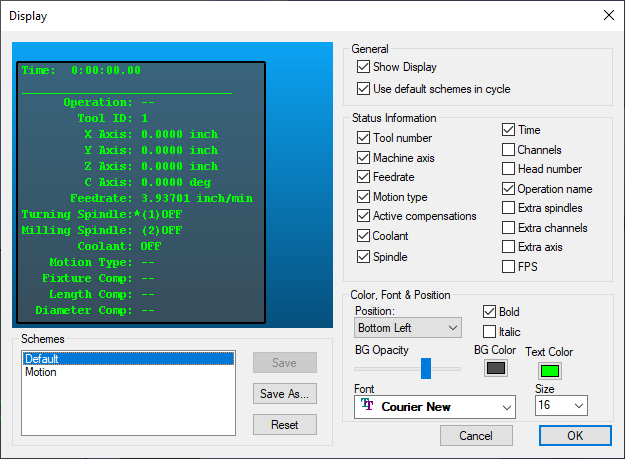
Head-Up Display
The HUD superimposes status
information on the simulation
window. To change the content or
position of the HUD, select the
Simulation» The FPS Status Information item can be selected to measure the simulation window display rate, in the form “FPS a / b” (useful when testing Graphic card setting). The number “a” is the theoretical maximum number of screen updates per second that VM could do if all it had to do was redraw the display. The number “b” is the actual number of updates per second, and takes into account all other processing requirements. |
|
Tool Path Display
Select the Simulation»
Select the Simulation»
Select Simulation»
|
VM Controller Time-Line
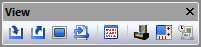
The VM Virtual Controller includes a Time-Line feature that can be used
to review and replay the simulation at any point. The VM controller can
be activated from the View toolbar by selecting the button shown circled
in the toolbar above. Select the button a second time to either hide the
controller window or to restore a controller window that has been
minimized. This window can also be controlled by selecting
Simulation»
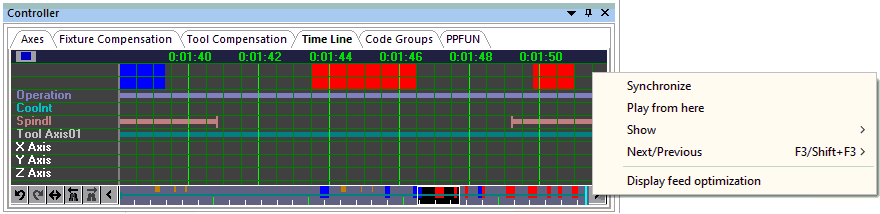
The time scale listed horizontally at the top of the window represents the run time of the process. The pale blue vertical bar shows the moment in time that the simulation window is currently showing. The light gray vertical line marks the end of the simulation. When MRS (material removal simulation) is active, all collisions involving the in-process stock (e.g., tool rapids into stock) are identified by horizontal amber bars at the top edge of the window; the left edge of the amber bar marks the start of the motion where a collision occurs and the corresponding right edge marks the start of the next motion where the in-process stock is again collision free. All other non in-process stock related collisions are identified by a red bar; the left edge of the red bar marks the moment in time where a collision occurs and the corresponding right edge marks the point where the simulation is again collision free. Each motion axis is listed horizontally. Motion axes overtravel conditions are individually identified by horizontal light purple bars drawn level with the axis on which an overtravel occurs; the left edge of the light purple bar marks the moment in time where an overtravel occurs and the corresponding right edge marks the point where the axis is once again within travel.
When the simulation is paused, you can click with the left mouse button
anywhere within the window to see, in the simulation window, the state
of the simulation at that moment in time. Hold the left mouse button
down and drag the mouse left and right to replay the simulation forwards
and backwards in time. Use the up and down arrow keys or the mouse wheel
to adjust the time scale to see more or less detail. The
Simulation»
Click with the right mouse button anywhere within the window to see a pop-up context menu. The “play from here” choice will replay the simulation from the selected point, using the continuous animation control setting. The “synchronize” choice will synchronize the selected moment in the timeline display with the simulation window and any of the other tracing windows available with the CERUN and GENER UI.
Part vs. Stock Comparison
Comparison between the design part and the in-process stock is only available with a MRS (Material Removal Simulation) license available and enabled via the SIM button on the GENER and CERUN launch panels. The MRS license provides the added functionality to compute the effect of the cutting process of the tool on the rough stock. The resultant shape is called the “in-process stock”.
The left-most of the circled buttons above toggles the display of the
in-process stock. The two buttons to its immediate right toggle the
display of Boolean Overcut (gouge) and Boolean Undercut (excess)
material. The gouge and excess calculations are done using an exact
comparison between in-process stock and its associated part. These
associations must first be setup using the “Associated Part” setting in
the Simulation»
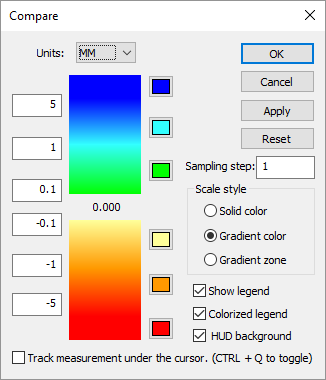
The Boolean excess and overcut results can sometimes be misleading,
since it can be difficult to judge the thickness of the excess or gouge
material. VM provides a Simulation»
The comparison is done by sampling the surface of the gouge and/
When viewing the gouge material in combination with either the part or the in-process stock, it helps to select the part with the mouse so that its surface becomes transparent, allowing the gouged material surface to be seen.