Code Properties Dialog (Control Emulator only)
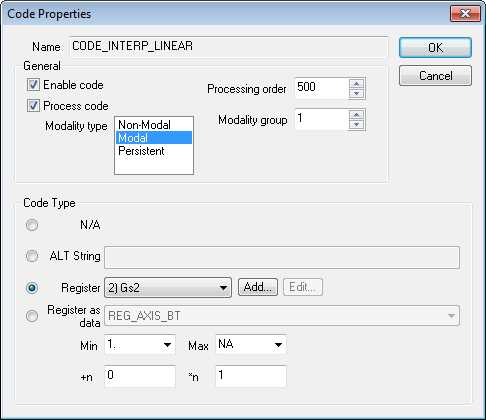
This dialog comes up when modifying one or more entries within the CODE customization section. It allow you to change the value of anyone of the customizable fields. Here is the description of those fields:
Name: Show the read-only identifier that is being modified. That field will be blank if modifying multiple entries at a time.
CODE_IGNORE: If the dialog was called by adding a new CODE, the name field will be a drop list instead of a non-editable text box. If the CODE_IGNORE choice is selected, then the behavior of the CODE will be to automatically ignore the matching pattern. Those codes are gonna be ignored at the order where they are supposed to be executed.
Enable code: A code being enabled will be recognized by the CE processing engine. Disable if you want to ignore a specific code, even if it was added by the questionnaire data.
Process code: Having this option enabled means that the code will be processed normally. If unchecked, the code will be recognized by the CE but will be ignored and discarded. This is a way to prevent specific actions for firing without outputting errors and warnings related to the code being unmatched.
Processing order: This number is the processing priority order of the codes being in the list. Lower numbers will be processed first. If two or more codes have the same order number and appear on the same block, then they will be processed by a standard left-to-right rule.
Modality group: The code grouping ID is used to identify which codes are in the same group. The groups are mainly used to manage the modality of the codes. Within each group, there can be only one active modal/
persistent code. (see next point below) Modality: This field identify the modality type of the code. The types are:
Non-Modal: Codes being non-modal will only fire an action on the blocks where they are physically coded.
Modal: Modal codes will fire action on blocks where they physically appear and will stay has the active code in their group. If a non-modal code of the same group is fired, the next block where no more code of the same group are present, the active modal code will re-fire its action.
Persistent: Persistent codes work like modal ones has they also become the active code of the group when they are fired. But also they keep firing the corresponding action on each subsequent blocks until another code from the same group take over. Usually, these are all the motion and cycle codes.
N/
A: A CODE of type N/ A do not match any register or text. It should only be used manually like being pushed on the current block by a $FCEADD() macro function and then caught using a CODE macro. ALT String: If the CODE is not using a register, it can use any string to be matched on the block. This is the use of the ALT string. Use this means there wont be any values attached to it. Whenever the string to match can have a value, it should be using a register and not an ALT string.
Register: This field identify the register that is in use by the code (if a register is used). Select the [Add...] button to define a new custom register if the required register format does not exist in the register drop-down list. Custom registers are identified by the string “(Custom)” in the drop-down list. Select the [Edit...] button to modify or delete the selected custom register. Take care to not delete a custom register being used for other purposes.
Register as data: Sometimes, a CODE need to use its own value as data to perform its action. For example, a tool preselect CODE_TOOL_SELECT will need to specify REG_TOOL as its own data usage. This means the code will fire the tool preselect action but the value of the code will be preserved for the action to get it just like it would have with another data register on the block.
Min: Used with a register to specify the minimum value or single value if the code do not have a range of values.
Max: Used with a register to specify the maximum value if the code is using a range of values. If two or more codes have conflicting value/
range, the code with the lower order number will always be the one matched. *n: This is a factor that will be multiplied to the code value after being matched.
+n: This is a number that will be added to the code value after being matched. Again, if used with the G54-59 range has a “-53” value. Then the value of the matched code that would be passed internally to the code macro for example would be 1-6.
Cancel: This button closes the Code Properties dialog without applying the changes to the item in the code customization list.
OK: This button closes the Code Properties dialog and apply the changes.