Coordinate System Functions
Coordinate system functions allow you to define, modify, and query coordinate frames within the Virtual Machine model. These functions support global and local coordinate systems, as well as model reference positions used for positioning and transformation.
The $FMSGCS Function
|
Returns the coordinate system information Returns: Sequence |


![\icamhsp{0.707mm}\raise0.05ex\hbox{$\biggl[,\mathit{mode}\Bigl[,\mathit{time}\,\bigl[,\mathit{channel}\,\bigr]\,\Bigr]\,\biggr]$}\icamhsp{0.707mm}\textbf{)}](../../_images/math/5f3487bbb79883b593196088fec5457d4f54c0de.svg)
The $FMSGCS function returns the coordinate system information of an object, optionally at a specified moment in time (default is current time) and in a specified channel (default is channel 1). The mode value determines the type of information returned, as shown below:
mode = 1Return either tool tip or machine information, as defined by id:id = 0 returns the tool tip coordinates in the RTCP frame.id = 1 returns the machine origin frame.mode = 2 (default)Return the world coordinate location of the component specified by the object id.mode = 3Return the coordinate location of the component specified by the object id in relation to its parent (i.e., the component to which it is attached in the simulation).A sequence of length 12 is returned containing a 3x4 matrix.
The $FMSGREF Function
|
Returns axes values for model reference positions Returns: Numeric or Sequence |



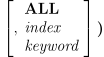
This form of the $FMSGREF function returns axes values for model reference positions, which are defined by the model creator (in QUEST) on a per channel basis. The n1 parameter specifies the channel of interest; use $VMCHN to specify the current active channel. The n2 parameter defines the reference position ID.
If the ALL keyword is specified, the return value is a sequence of length 16 containing the reference position axes values for all possible axes. Otherwise, the return value is a sequence of length 6 containing the reference position axes values for the active axes (as defined by the $AXES system variable). A sequence of zeros is returned if the reference position ID n2 is not defined in channel n1.
Similar to the above, this form of the $FMSGREF function returns the reference position value for the specified axis, identified either by an index number or by a keyword identifier (a table of valid index numbers and keywords can be found here). A value of zero is returned if the reference position ID n2 is not defined in channel n1 or if axis is not defined in the post-processor or control emulator.
![\icamhsp{0.707mm}\bigl[,\textbf{ALL}\,\bigr]\icamhsp{0.707mm}\textbf{)}](../../_images/math/d0fc3050c7d790a6883111ac69435be10b5ff554.svg)


The $FMSLCS Function
|
Setup a local coordinate system transformation Returns: Numeric (always returns 1) |
![\textbf{{\char36}FMSLCS}\textbf{(}\icamhsp{0.707mm}\bigl[\,\mathit{matrix}\,\bigr]\icamhsp{0.707mm}\textbf{)}](../../_images/math/5fd249880f3b1ffde14cbf1ad8e4c3aa9d4b0102.svg)
The $FMSLCS function is used to setup a local coordinate system transformation on the simulation machine. The matrix argument is a sequence that must contain the 12 numeric elements of a 3x4 matrix.
Call the $FMSLCS function without the matrix sequence to disable local coordinate processing and return to normal coordinate processing.
The $FMSSCS Function
|
Sets the coordinate system information of components Returns: Sequence |


The $FMSSCS function sets the coordinate system information of the component specified by the object id, optionally at a specified moment in time (default is current time) in a specified channel (default is channel 1). The mode value determines how the 3x4 matrix sequence is interpreted, as follows:
mode = 2 (default)Sets the world coordinate location of the component specified by the object id. If optional timing data is specified, then the relationship of the component to its parent is computed at that time in the simulation, but the repositioning of the component with respect to its parent happens at the current time. I.e., this function does not retroactively reposition components.mode = 3Sets the coordinate location of the component specified by the object id in relation to its parent (i.e., the component to which it is attached in the simulation). Optional timing data is ignored.Only objects of the following types can be set:
- 3:
Reference axis component
- 8:
Stock component
- 9:
Fixture component
- 10:
Part component
- 12:
Tool component
- 14:
Head component
- 16:
Assembly container (17:Part, 9:Fixture)
- 17:
Part container (10:Design, 8:Stock)
- 18:
CAM system coordinate frame
A non-zero value is returned if the function is successful.
The $FMSSREF Function
|
Sets axes values for model reference positions Returns: Numeric (always returns 1) |

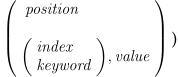
This form of the $FMSSREF function sets axes values for model reference positions, which will overwrite any position already defined by macro or by the model creator in QUEST. The n1 parameter specifies the channel of interest; use $VMCHN to specify the current active channel. The n2 parameter defines the reference position ID.
A sequence of 3, 6 or 16 values can be specified for the reference position. A sequence of 3 will set the reference position for the X, Y and Z axes. A sequence of 6 will set the reference position for the active axis as defined by the $AXES system variable. A sequence of 16 will set the reference position for all axes.
Similar to the above, this form of the $FMSSREF function replaces the reference position value for the specified axis, identified either by an index number or by a keyword identifier (a table of valid index numbers and keywords can be found here).


