Matrix Functions
Matrix functions work with sequences of length 12 that define the APT standard rotation and translation components of a matrix. For example:
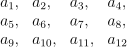
Matrix functions can also work with square matrices of any dimension, defined as a series of numbers that represent a matrix organized in row-column order. For example:

Matrix functions that return a matrix, vector or point sequence do so by returning a sequence with the same length as that of the input matrix, vector or point sequence.
Matrices can be constructed using the $FSEQ function or the { } sequence operators. For example, the following are equivalent:
M1=$FSEQ(1,0,0,0,0,1,0,0,0,0,1,0)
M1={1,0,0,0,0,1,0,0,0,0,1,0}
It is important to note that matrices are sequences and not arrays. Matrix functions do not work with arrays.
The $FMX Function
|
Matrix creation Returns: Sequence |

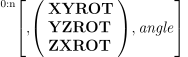
The $FMX function returns a 12 element matrix sequence as defined by the standard <matrix> post-processor command syntax listed below:
where <rotation> is defined as:
A full description of the <matrix> syntax can be found in “The ORIGIN Command [MLEPC]”.
![\bigl[\,\textbf{INVERS},\bigr]\begin{pmatrix}\!\begin{array}{l}\Bigl[\,\mathit{x_{1}},\mathit{y_{1}}\,\bigl[,\mathit{z_{1}}\,\bigr]\,\Bigr]\,\bigl[\,\mathtt{<\!rotation\!>}\,\bigr]\\\;\\\textbf{MSYS}\,\bigl[,\textbf{LAST}\,\bigr]\\\;\\\mathit{a_{1}},\mathit{a_{2}},\mathit{a_{3}},\mathit{a_{4}},\mathit{a_{5}},\mathit{a_{6}},\mathit{a_{7}},\mathit{a_{8}},\mathit{a_{9}},\mathit{a_{10}},\mathit{a_{11}},\mathit{a_{12}}\end{array}\!\end{pmatrix}](../../_images/math/1b9c20c0d3688e56a3194e516a3b6928cc3d5715.svg)
![\raise0.03ex\hbox{$\Bigl[,\textbf{AT},\mathit{x_{c}},\mathit{y_{c}}\,\bigl[,\mathit{z_{c}}\,\bigr]\,\Bigr]$}\icamhsp{0.707mm}](../../_images/math/5f70b9d11c59069c4f29c33a1d0271ee3ca965bb.svg)
![\raise0.03ex\hbox{$\Bigl[,\textbf{TRANS},\mathit{x_{2}},\mathit{y_{2}}\,\bigl[,\mathit{z_{2}}\,\bigr]\,\Bigr]$}](../../_images/math/a6f353d320736eb84b23e574ee0eba57dde38bcc.svg)
The $FMXINV Function
|
Matrix inversion Returns: Sequence |

The $FMXINV function inverts the matrix sequence m, then returns the result as a matrix sequence.
The $FMXMULT Function
|
Matrix multiplication Returns: Sequence |

The $FMXMULT function multiplies matrix m1 by m2, then returns the result as a matrix sequence. A diagnostic will be output and macro processing will fail if both matrices do not have the same dimensions.
The $FMXTRFP Function
|
Point transformation by matrix Returns: Sequence |

The $FMXTRFP function transforms a point p, defined as a sequence of arbitrary length, by the matrix m, then returns the translated and rotated result as a point sequence. This function only solves for the minimum number of common dimensions. Unsolved excess point dimensions are not transformed in the output point sequence.
The $FMXTRFV Function
|
Vector transformation by matrix Returns: Sequence |

The $FMXTRFV function transforms a vector v, defined as a sequence of arbitrary length, by the matrix m, then returns the rotated result as a vector sequence. This function only solves for the minimum number of common dimensions. Unsolved excess vector dimensions are not transformed in the output vector sequence.
The $FMXTRSP Function
|
Matrix transposition Returns: Sequence |

The $FMXTRSP function transposes the matrix sequence m, then returns the result as a matrix sequence.
The $FMXTYPE Function
|
Matrix type Returns: Sequence |
![\textbf{{\char36}FMXTYPE}\textbf{(}\icamhsp{0.707mm}\mathit{m}\,\bigl[,\mathit{type}\,\bigr]\icamhsp{0.707mm}\textbf{)}](../../_images/math/aaf6bcc100e2b2dea3093bf0d3df97f20351091e.svg)
The $FMXTYPE function returns a numeric value that identifies the transformation type of a matrix m. Return values are as follows:
- 0:
The matrix consists entirely of zeroes
- 1:
Identity
- 10:
Translation
- 100:
Rotation (9 decimal digit or better accuracy)
- 200:
Rotation and/
or scaling and/ or mirroring - 1000:
Scale
- 10000:
Mirror
Translation is only checked for 3x4 and homogeneous 4x4 matrixes. A matrix with combined translation and rotation will return the value 110. Similarly, a matrix with combined scaling and translation will return 1010 and a matrix with combined mirroring and translation will return 10010. Scaling and mirroring cannot be detected when combined with rotation. A matrix containing such a combined transformation, or a matrix containing rotation defined using vectors with 8 or fewer digits of precision, will return a type 200 (or 210 if combined with translation).
An optional type keyword can be given to test for a specific transformation type. A value of zero is returned if the transformation is not present, otherwise the return value is as listed above. The type keyword must be one of the following:
- TRANS:
Translation
- ROTATE:
Rotation
- SCALE:
Scaling
- MIRROR:
Mirroring
For example, the following IF block tests a matrix M for various transformations:
IF/$FMXTYPE(M).EQ.1
  identity
ELSEIF/$FMXTYPE(M,TRANS).GT.0
  translation
ELSEIF/…
  …
ENDOF/IF