Matrix Functions
Matrix functions work with sequences of length 12 that define the APT standard rotation and translation components of a matrix. For example:
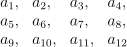
Matrix functions can also work with square matrices of any dimension, defined as a series of numbers that represent a matrix organized in row-column order. For example:

Matrix functions that return a matrix, vector or point sequence do so by returning a sequence with the same length as that of the input matrix, vector or point sequence.
Matrices can be constructed using the $FSEQ function or the { } sequence operators. For example, the following are equivalent:
M1=$FSEQ(1,0,0,0,0,1,0,0,0,0,1,0)
M1={1,0,0,0,0,1,0,0,0,0,1,0}
It is important to note that matrices are sequences and not arrays. Matrix functions do not work with arrays.
The $FMX Function
|
Matrix creation Returns: Sequence |

The $FMX function returns a 12 element matrix sequence as defined by the standard <matrix> post-processor command syntax listed below:
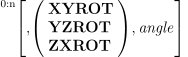
where <rotation> is defined as:
The <matrix> can be specified as an optional x1 y1 z1 translation followed by zero or more rotations about the XY, YZ and ZX axes. Rotation is about the origin unless an optional rotation center point is defined using xc yc zc. An additional translation with respect to the as-rotated frame can be defined using x2 y2 z2. The matrix can also be specified using the 12 numeric values of an APT standard matrix definition. The INVERS keyword inverts the matrix definition.
![\bigl[\,\textbf{INVERS},\bigr]\begin{pmatrix}\!\begin{array}{l}\Bigl[\,\mathit{x_{1}},\mathit{y_{1}}\,\bigl[,\mathit{z_{1}}\,\bigr]\,\Bigr]\,\bigl[\,\mathtt{<\!rotation\!>}\,\bigr]\\\;\\\textbf{MSYS}\,\bigl[,\textbf{LAST}\,\bigr]\\\;\\\mathit{a_{1}},\mathit{a_{2}},\mathit{a_{3}},\mathit{a_{4}},\mathit{a_{5}},\mathit{a_{6}},\mathit{a_{7}},\mathit{a_{8}},\mathit{a_{9}},\mathit{a_{10}},\mathit{a_{11}},\mathit{a_{12}}\end{array}\!\end{pmatrix}](../../_images/math/1b9c20c0d3688e56a3194e516a3b6928cc3d5715.svg)
![\raise0.03ex\hbox{$\Bigl[,\textbf{AT},\mathit{x_{c}},\mathit{y_{c}}\,\bigl[,\mathit{z_{c}}\,\bigr]\,\Bigr]$}\icamhsp{0.707mm}](../../_images/math/5f70b9d11c59069c4f29c33a1d0271ee3ca965bb.svg)
![\raise0.03ex\hbox{$\Bigl[,\textbf{TRANS},\mathit{x_{2}},\mathit{y_{2}}\,\bigl[,\mathit{z_{2}}\,\bigr]\,\Bigr]$}](../../_images/math/a6f353d320736eb84b23e574ee0eba57dde38bcc.svg)
The $FMXINV Function
|
Matrix inversion Returns: Sequence |

The $FMXINV function inverts the matrix sequence m, then returns the result as a matrix sequence.
The $FMXMULT Function
|
Matrix multiplication Returns: Sequence |

The $FMXMULT function multiplies matrix m1 by m2, then returns the result as a matrix sequence. A diagnostic will be output and macro processing will fail if both matrices do not have the same dimensions.
The $FMXTRFP Function
|
Point transformation by matrix Returns: Sequence |

The $FMXTRFP function transforms a point p, defined as a sequence of arbitrary length, by the matrix m, then returns the translated and rotated result as a point sequence. This function only solves for the minimum number of common dimensions. Unsolved excess point dimensions are not transformed in the output point sequence.
The $FMXTRFV Function
|
Vector transformation by matrix Returns: Sequence |

The $FMXTRFV function transforms a vector v, defined as a sequence of arbitrary length, by the matrix m, then returns the rotated result as a vector sequence. This function only solves for the minimum number of common dimensions. Unsolved excess vector dimensions are not transformed in the output vector sequence.
The $FMXTRSP Function
|
Matrix transposition Returns: Sequence |

The $FMXTRSP function transposes the matrix sequence m, then returns the result as a matrix sequence.
The $FMXTYPE Function
|
Matrix type Returns: Sequence |
![\textbf{{\char36}FMXTYPE}\textbf{(}\icamhsp{0.707mm}\mathit{m}\,\bigl[,\mathit{type}\,\bigr]\icamhsp{0.707mm}\textbf{)}](../../_images/math/aaf6bcc100e2b2dea3093bf0d3df97f20351091e.svg)
The $FMXTYPE function returns a numeric value that identifies the transformation type of a matrix m. Return values are as follows:
- 0:
The matrix consists entirely of zeroes
- 1:
Identity
- 10:
Translation
- 100:
Rotation (9 decimal digit or better accuracy)
- 200:
Rotation and/
or scaling and/ or mirroring - 1000:
Scale
- 10000:
Mirror
Translation is only checked for 3x4 and homogeneous 4x4 matrixes. A matrix with combined translation and rotation will return the value 110. Similarly, a matrix with combined scaling and translation will return 1010 and a matrix with combined mirroring and translation will return 10010. Scaling and mirroring cannot be detected when combined with rotation. A matrix containing such a combined transformation, or a matrix containing rotation defined using vectors with 8 or fewer digits of precision, will return a type 200 (or 210 if combined with translation).
An optional type keyword can be given to test for a specific transformation type. A value of zero is returned if the transformation is not present, otherwise the return value is as listed above. The type keyword must be one of the following:
- TRANS:
Translation
- ROTATE:
Rotation
- SCALE:
Scaling
- MIRROR:
Mirroring
For example, the following IF block tests a matrix M for various transformations:
IF/$FMXTYPE(M).EQ.1
  identity
ELSEIF/$FMXTYPE(M,TRANS).GT.0
  translation
ELSEIF/…
  …
ENDOF/IF